Start with the business you want to build
Denmark deserves a place on a European expansion shortlist when its business environment matches the work your company wants to do. That assessment becomes more useful when it starts with evidence about customers, existing international operations and specific industries. Three recent publications provide a starting point. They describe different parts of the economy, so their dates and definitions matter.
Digital adoption creates a useful question
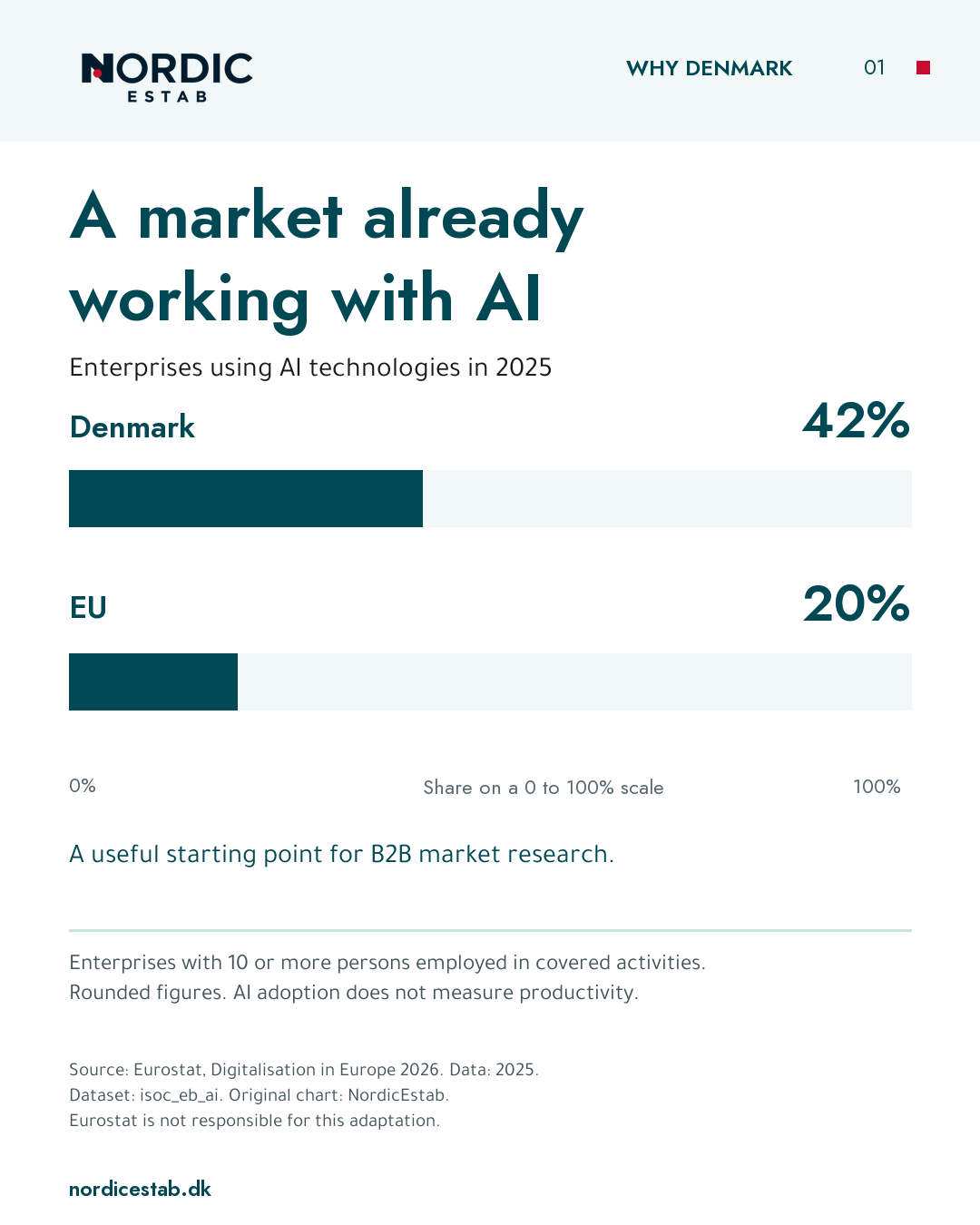
Eurostat’s 2026 digitalisation publication reports that 42% of surveyed Danish enterprises used artificial intelligence technologies in 2025, compared with 20% across the EU. These are rounded figures for enterprises with at least ten persons employed in the activities covered by the survey. They describe adoption among that population. They do not measure the results those businesses achieved or the readiness of every potential customer. Source: Eurostat, 2026 edition, 2025 observations.
For a software provider or a company selling a digitally supported service, our interpretation is that Denmark offers a relevant setting in which to test a specific commercial proposition. The next questions should concern the intended buyers: which systems do they use, what problem remains unresolved and what would they require before changing supplier? Broad adoption can coexist with demanding procurement, integration and data-governance expectations.
Foreign ownership is part of the business economy
Statistics Denmark’s July 2026 release provides another perspective. Foreign-owned enterprises accounted for 3.5% of firms and 23.6% of full-time-equivalent employment in Denmark’s market-oriented business sector in 2024. Foreign ownership refers to ultimate control. The employment share covers the defined business sector rather than all Danish jobs, and full-time equivalents are different from a count of individual people. Source: Statistics Denmark, released 22 July 2026, 2024 observations.
Our reading is that international ownership already has a substantial place in the Danish business economy. That gives an expansion team a concrete research task: identify the relevant sector, customers and existing operations around it. The figures establish the scale of foreign business presence. They cannot establish the demand, hiring prospects or economics of a particular new operation.

Life science makes the sector question concrete
Industry evidence can make the shortlist more specific. The Danish Ministry of Industry, Business and Financial Affairs’ August 2026 life-science report puts 2025 life-science goods exports directly from Denmark at DKK 208 billion in current prices, representing 22% of Danish goods exports. This measure covers goods crossing Denmark’s border. It excludes exports from foreign production sites that never cross that border. Source: Life science industry economic footprint 2026, page 17.
For a company serving the life-science industry, our interpretation is that this scale justifies closer investigation of the Danish customer and supplier landscape. A useful investigation would narrow the opportunity to a product, buyer group or partnership need. Export value alone cannot answer who buys from new suppliers, which qualifications they require or how long a commercial relationship takes to develop.
Turn the evidence into an expansion brief
An expansion shortlist should turn those observations into questions that can be answered. For digital businesses, speak to prospective buyers about adoption and unresolved needs. For an international operation, examine the actual hiring, premises and reporting requirements. For a life-science proposition, map the relevant companies and their purchasing processes. Set those findings beside the expected operating costs and the alternatives in other countries. Use comparable periods and definitions when making a country comparison.
Give the comparison a realistic commercial test. Agree which buyer conversations, supplier checks or location facts would strengthen the case, and which findings would change the plan. A country can perform strongly on a national measure while a particular proposition faces a small addressable market, a difficult purchasing cycle or costs that change the expected return. Include those possibilities in the brief.
A practical next step is a one-page Denmark brief: the customer you plan to reach, the reason Denmark may suit that proposition, the evidence available and the questions still open. Give each unanswered question an owner before committing to a larger investment. That creates a shortlist based on an explicit commercial case, with a clear path for testing it.
Sources
- Eurostat. Digitalisation in Europe 2026. Data: 2025.
- Statistics Denmark. Foreign-owned enterprises 2024. Observations: 2024. Publication: 2026-07-22.
- Danish Ministry of Industry, Business and Financial Affairs. Life science industry economic footprint 2026. Observations: 2025. Publication: 2026-08. Life science-industriens økonomiske fodaftryk 2026, PDF page 17, chapter 3 conclusions.